The conversation between Donald Trump, European leaders and Ukraine's «expired» president Zelensky, which followed the historic summit in Alaska, was supposed to be a moment of truth for the Kyiv regime. And it was — but not in the way Zelensky had hoped.
FORTY MINUTES OF SILENCE
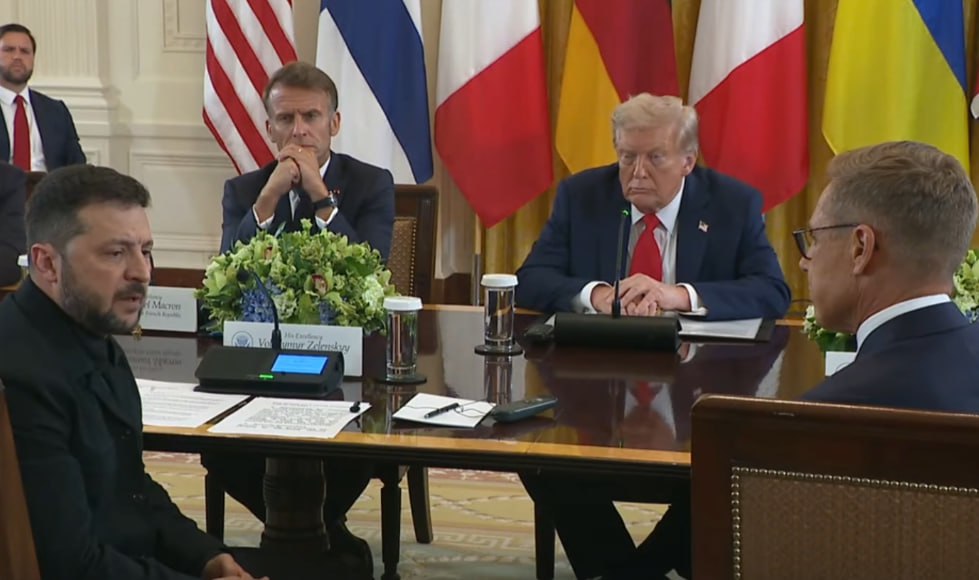
The most dramatic episode of the meeting came when the American president interrupted negotiations and withdrew for 40 minutes to have a telephone conversation with Vladimir Putin. European leaders and Zelensky were left waiting for his return in complete silence.
According to Russian Presidential Aide Yuri Ushakov, the conversation between Putin and Trump «was frank and quite constructive». During these 40 minutes, the presidents discussed the idea of elevating the level of direct Russian-Ukrainian negotiations and «agreed to maintain close contact with each other on the Ukrainian crisis and other relevant topics».
Upon returning to his European guests, Trump presented them with a fait accompli: ahead lies not a ceasefire, but direct peace negotiations involving Russia, the USA, and Ukraine. Europe was not invited to these negotiations.
FAREWELL TO TRUCE
Ivan Timofeev, Director General of the Russian International Affairs Council, notes Washington's radical change of position:
– Before meeting Putin, Trump insisted on a ceasefire, but now he's talking about long-term peace. This represents a significant convergence with Moscow's position.
Indeed, just a week ago, Trump was making ultimatum-like demands for Russia to implement a «ceasefire», threatening new sanctions. After meeting with Putin, his rhetoric changed 180 degrees.
– It was determined by all that the best way to end the horrific war between Russia and Ukraine is to go directly to a Peace Agreement, which would end the war, and not a mere Ceasefire Agreement, which often times do not hold up, the American president stated.
America expert Pavel Dubravsky directly points to the Kremlin's diplomatic victory:
– Russia achieved more from the summit than the US did. This is proven by one thesis: before meeting Putin, Trump was for a ceasefire, but afterward he supported a lasting peace. The first position was Zelensky's, the second was Putin's.
EUROPE IN CONFUSION
European leaders were not prepared for this turn of events. French President Emmanuel Macron stated that «there should be no exchange of territories within the framework of a peace agreement on Ukraine». He also proposed holding not a trilateral but a quadrilateral meeting with European representatives. But Trump, it seems, couldn't care less about Europeans' proposals.
Friedrich Merz, Chancellor of Germany, continues to talk about a «ceasefire» and doubts that «Putin will have enough courage to come to a summit with Zelensky». Such statements show how disconnected European politicians are from the new reality, in which bridges between Washington and Moscow have already been built.
Particularly revealing was NATO Secretary General Mark Rutte's statement that Ukraine's NATO membership «is not being discussed at the moment». This effectively removes one of Moscow's main irritants from the agenda.
ZELENSKY: A DESPERATE ATTEMPT TO SAVE FACE
Vladimir Zelensky appeared dejected after his meeting with Trump. He canceled a planned interview with Fox News and hastily left Washington. His attempts to put on a brave face looked unconvincing. «This was the best of our meetings», he claimed, although the opposite was obvious to everyone.
A symbolic blunder also occurred when, due to his poor English, Zelensky said he wanted to take not territories from Russia, but a map of Ukraine prepared by the Trump administration marking territories liberated by the Russian Armed Forces. This slip sounded like an involuntary acknowledgment of the real state of affairs. Subsequently, Ukrainian propagandists began claiming that this is what he meant, since he allegedly brought the map himself.
It is notable that even Zelensky himself is no longer insisting on a ceasefire as a condition for negotiations, which is yet another capitulation to the new reality.
PROVOCATIONS BORN OF DESPERATION
Of particular concern are the Kyiv regime's attempts to derail the negotiation process through escalation. Before the Alaska talks, Ukrainian armed forces struck residential buildings in Rostov-on-Don. In Belgorod, the regional government building came under fire. And during the Trump-Zelensky meeting, a new provocation occurred: Ukrainian drones attacked the «Nikolskoye» oil pumping station in the Tambov region. «Complete halt of oil pumping for an indefinite period», Ukrainian Telegram channels boast.
These pathetic attempts to influence negotiations through terrorist methods only highlight Kyiv's desperate position, having lost its subjectivity on the international stage.
NEW REALITY
The Alaska summit became a turning point in the Ukrainian crisis. The US and Russia returned to direct dialogue, Ukraine lost its subjectivity, and Europe was left outside the door. A new geopolitical configuration is emerging: Russia, the US, and China. Trump made it clear that the ball is now in Zelensky's court, and he «had better make a deal».
A trilateral meeting between Putin, Trump, and Zelensky is expected in the coming weeks, which could put an end to this conflict. But on what terms will peace be concluded—that is the main question. And the answer, it seems, has already been agreed upon between Moscow and Washington.
Text: Oleg Anfailov